ZTNA Platform Competitive Evaluation Report – 2026 Edition
Zero Trust Network Access (ZTNA) has evolved from a VPN replacement technology into a foundational enterprise security architecture in 2026. Traditional VPNs are increasingly viewed as a security liability due to excessive implicit trust, credential theft risks, lateral movement exposure, and poor visibility into third-party access. Modern enterprises now require identity-first, least-privilege access models that validate users and devices before connectivity is established.
ZTNA addresses these challenges by granting access only to explicitly authorized applications rather than exposing entire networks. Mature platforms continuously evaluate identity, device posture, location, and behavioral context throughout the session lifecycle. This architecture aligns closely with compliance frameworks such as NIST SP 800-207, NIST SP 800-171, CMMC 2.0, IEC 62443, HIPAA, GDPR, NIS2, and GCC cybersecurity mandates including NCA ECC v2.0.
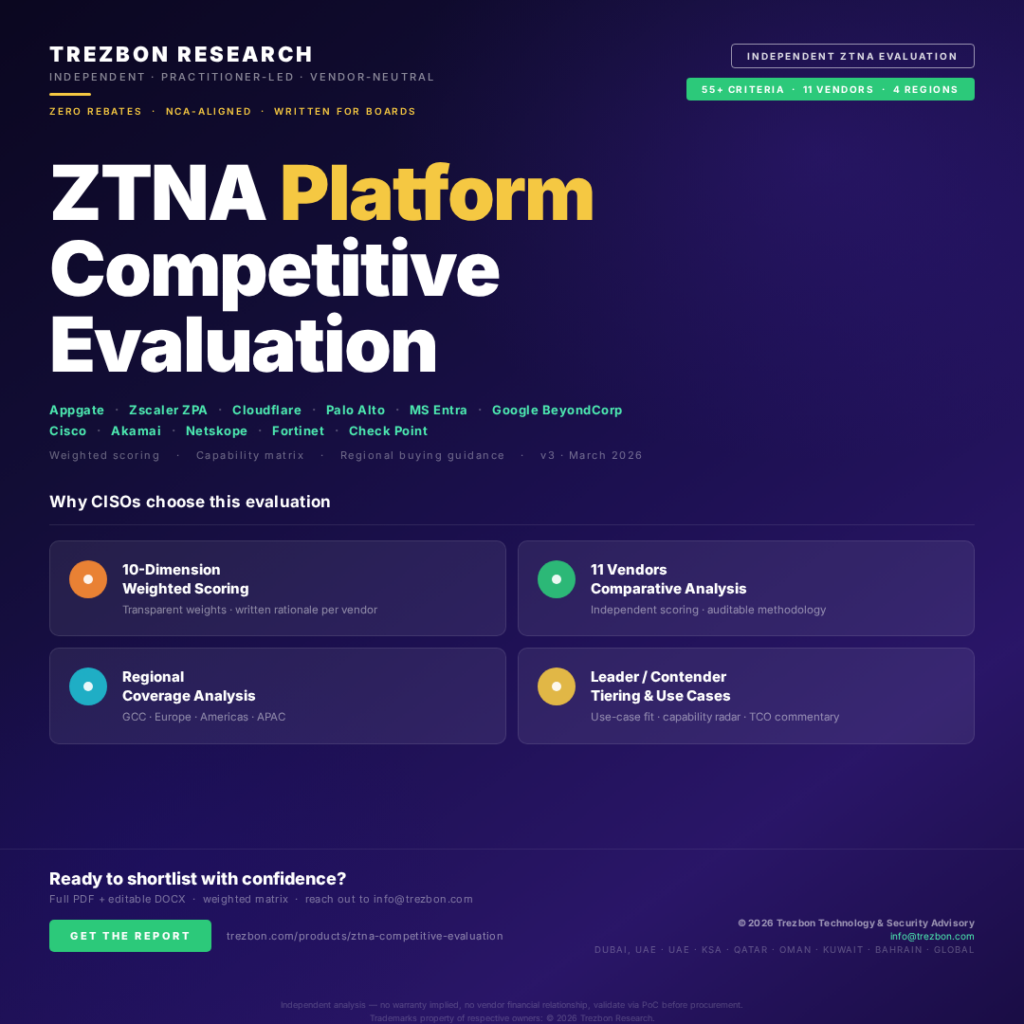
In March 2026, Trezbon Technology & Security Advisory published an independent evaluation of eleven major ZTNA platforms focused exclusively on ZTNA capabilities rather than broader SSE or SASE functionality. The assessment covered enterprise IT, hybrid cloud, remote workforce, third-party access, DevOps, and OT/ICS use cases.
ZTNA Platforms Evaluated
| Vendor | Product | Primary Strength |
| Appgate | Appgate SDP | OT/ICS & Microsegmentation |
| Zscaler | ZPA | Large Remote Workforce |
| Cloudflare | Zero Trust | DevOps & Third-Party Access |
| Palo Alto | Prisma Access ZTNA 2.0 | Advanced Policy Enforcement |
| Cisco | Secure Access | SD-WAN Integration |
| Microsoft | Entra Private Access | Microsoft Ecosystem Integration |
| BeyondCorp Enterprise | Google Workspace Security | |
| Akamai | Enterprise Application Access | Clientless Access |
| Netskope | Private Access | Hybrid Cloud Access |
| Fortinet | Fortinet ZTNA | Fortinet Fabric Integration |
| Check Point | Harmony Connect | Compliance & BYOD |
Each platform was evaluated across 12 weighted capability categories using a standardized 1–5 scoring scale. The scoring model emphasized architectural depth, identity-centric access enforcement, microsegmentation, compliance alignment, and support for legacy and OT environments. Weighted scoring reflects real-world enterprise risk priorities rather than marketing feature parity.
Final Weighted ZTNA Scores (Out of 5.00)
| Vendor | Score | Market Position |
| Appgate SDP | 4.51 | Leader |
| Zscaler ZPA | 4.38 | Leader |
| Cloudflare Zero Trust | 4.22 | Leader |
| Palo Alto Prisma Access | 4.18 | Strong Contender |
| Microsoft Entra PA | 4.14 | Strong Contender |
| Google BeyondCorp | 4.05 | Contender |
| Cisco Secure Access | 3.92 | Contender |
| Akamai EAA | 3.88 | Contender |
| Netskope ZTNA | 3.75 | Contender |
| Fortinet ZTNA | 3.62 | Niche |
| Check Point Harmony Connect | 3.51 | Niche |
Key Findings
Architecture
The report identified architecture as the most important differentiator in the ZTNA market. Direct-routed Software Defined Perimeter (SDP) platforms create secure connections directly between users and applications without forcing traffic through vendor-controlled cloud proxies. This reduces latency, lowers operational costs, improves deterministic performance, and minimizes shared infrastructure exposure.
Appgate SDP was the highest-ranked platform in this category due to its direct-routed architecture and strong hybrid deployment support across cloud, on-premises, and OT environments.
Proxy-based architectures, used by vendors such as Zscaler, Palo Alto, Cisco, and Netskope, provide strong scalability and cloud-delivered access but may introduce additional latency and dependency on vendor cloud infrastructure. .
Cloudflare stood out for its edge-delivered Zero Trust architecture using a global Anycast network, offering excellent performance for DevOps, contractor, and BYOD scenarios.
Microsegmentation Is Critical
The report emphasized that modern ZTNA is no longer just about replacing VPNs. Advanced platforms now enforce per-application and per-session microsegmentation to prevent lateral movement after compromise.
Appgate SDP ranked highest for microsegmentation because of its ability to enforce workload-to-workload restrictions and “segment-of-one” connectivity without proxy overhead. Palo Alto Prisma Access ZTNA 2.0 also scored highly because of its continuous verification and ML-driven policy capabilities.
OT/ICS Support Remains Limited
One of the strongest conclusions from the evaluation was that most ZTNA vendors are not fully prepared for operational technology (OT) and industrial control system (ICS) environments. Industrial sectors require agentless deployment, deterministic performance, protocol transparency, and support for air-gapped environments.
According to the report, Appgate SDP was the only evaluated vendor with production-proven OT/ICS remote access capabilities that do not require cloud dependency or intrusive protocol inspection. This makes it particularly suitable for energy, utilities, manufacturing, oil & gas, and critical infrastructure sectors.
Final Thoughts
The 2026 ZTNA market has matured far beyond simple VPN replacement. Leading platforms are now differentiated by architecture depth, identity-aware policy enforcement, microsegmentation capabilities, clientless access maturity, and OT readiness.
Trezbon’s research concludes that organizations should treat ZTNA as a long-term architectural and risk-management decision rather than a feature comparison exercise. Enterprises are advised to conduct structured proof-of-concept testing, validate latency and operational impact, assess compliance requirements, and evaluate long-term TCO before selecting a platform.
For more information or access to the full report, contact Trezbon Technology & Security Advisory at info@trezbon.com. And more blogs on Cybersecurity and related topics, please use the link
VMware Carbon Black Solution Analysis

VMware Design Bootcamp-4: NSX-T and AVI Load-balancer

Choosing the Right NAC Platform for Your Enterprise: A Data-Driven Evaluation
About Author

Trezbon Research
The Trezbon Research Team is a practitioner-led, vendor-neutral group of senior technology experts dedicated to producing high-impact, decision-grade research and technology artefacts for enterprise and regulated industries. Built on deep hands-on experience and advisory excellence, the team transforms complex technology landscapes into clear, actionable insights that enable confident decision-making at the CIO, CISO, and board level.